
Electrical protection plays an important role in keeping homes, workplaces and equipment safe. When too much current flows through a circuit, electrical components can overheat, equipment can become damaged, and fire risks may increase. Fuses and circuit breakers help reduce these risks by interrupting the current when certain fault conditions occur.
Although both devices serve a protective purpose, they work differently and suit different applications. Understanding the difference between a fuse and a circuit breaker can help property owners recognise when an existing electrical system may need professional assessment.
This guide explains how each device works, compares its practical advantages, explores common applications and outlines what to consider when evaluating electrical protection.
What Is a Circuit Breaker and How Does It Work?
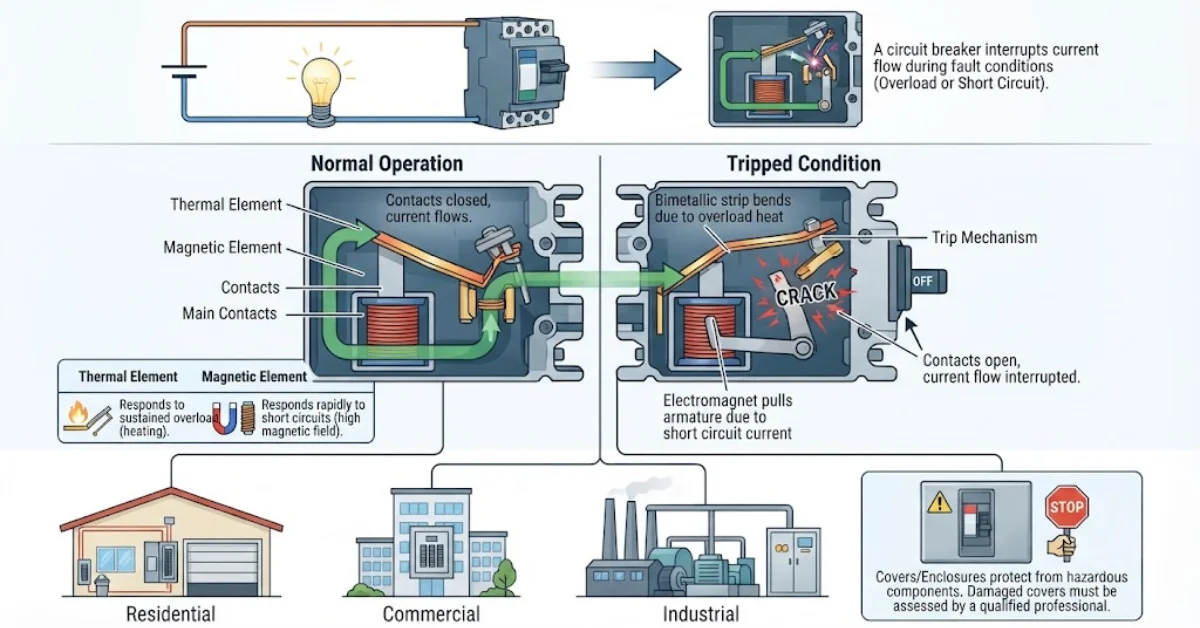
A circuit breaker is an electrical switching device designed to interrupt current when specified fault conditions occur. Depending on its design, it can respond to an overload, a short circuit or another condition covered by its protective functions.
Many common circuit breakers use thermal and magnetic mechanisms. The thermal mechanism responds to sustained excessive current, while the magnetic mechanism can respond rapidly to sufficiently high fault current. Other breaker designs use different operating technologies.
When the protective mechanism operates, the breaker opens the circuit and interrupts the flow of electricity. Unlike a conventional replaceable fuse, a suitable circuit breaker can generally be reset after it has tripped, provided the fault has been identified and it is safe to restore power. Learn more about circuit breaker replacement and the considerations involved.
Circuit breakers are widely used in residential switchboards, commercial buildings and industrial electrical distribution systems. Their ratings and characteristics must suit the circuit, equipment and installation requirements.
Where Are Circuit Breakers Used?
In homes, circuit breakers commonly protect individual circuits supplying lighting, power points and appliances. Commercial properties may use them to protect equipment, distribution boards and dedicated circuits, while industrial facilities require devices selected for their particular electrical loads and fault conditions.
A circuit breaker cover or suitable enclosure also plays an important role in protecting people from accidental contact with hazardous components. Damaged, missing or poorly fitted covers should be assessed by a qualified electrical professional.
What Is a Fuse and How Does It Work?
A fuse is an overcurrent protection device containing an element designed to melt when excessive current passes through it for a sufficient period. When the element melts, the electrical path is interrupted, helping limit the effects of the fault.
Fuses come in different designs, sizes and ratings. Some are intended for electronic equipment or vehicle circuits, while others are designed for building installations, machinery or specialised electrical applications.
Once a conventional fuse operates, its element cannot be reused. The cause of the fault must be investigated, and the fuse must be replaced with the correct type and rating by an appropriately qualified person where required.
Using an unsuitable replacement or bypassing the protective element can compromise safety. The correct rating depends on the equipment manufacturer’s specifications, the circuit and the installation’s protection requirements.
Common Applications of Fuses
Fuses remain useful in many applications because they provide straightforward overcurrent protection. They may be found in vehicle electrical systems, electronic equipment, specialised machinery and some older building installations.
An auto fuse, for example, is designed for a particular vehicle circuit and must match the relevant specifications. Industrial installations may use specialised fuse arrangements selected for the equipment and expected fault conditions.
A service fuse holder is a different consideration because it may form part of the incoming electricity supply equipment.
Work on supply-side components should be handled by the relevant electricity provider or an appropriately authorised professional, as applicable. For related electrical installation information, see ceiling fan installation cost.
Electrical Fuses vs Circuit Breakers: Key Differences
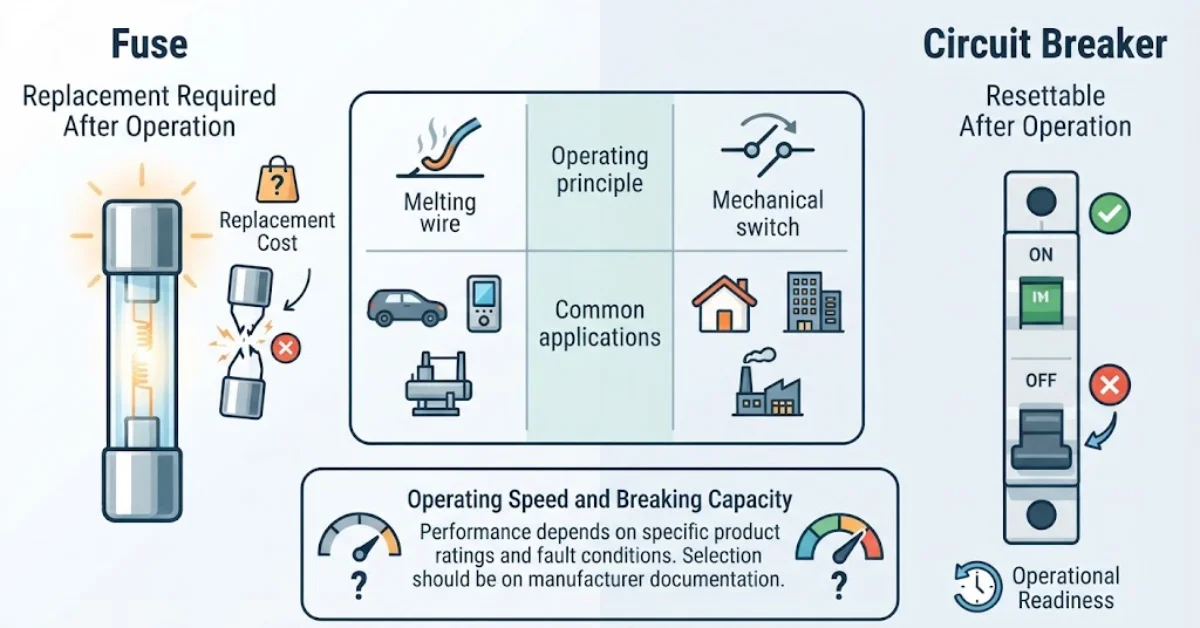
Both devices interrupt electrical current under specified fault conditions, but their operating mechanisms, replacement requirements and applications differ. These distinctions are important when evaluating an existing installation.
| Feature | Fuse | Circuit breaker |
| Operating principle | A protective element melts to interrupt current | A switching mechanism opens the circuit |
| After operation | The fuse generally needs replacement | The breaker can generally be reset after the fault is addressed |
| Protection | Provides protection according to its design and rating | Provides protection according to its design and rating |
| Common applications | Vehicles, electronics, equipment and some building installations | Residential, commercial and industrial distribution systems |
| Ongoing considerations | Correct replacement type and rating are essential | Correct selection, condition and operation remain important |
| Cost considerations | Replacement components may be relatively inexpensive | Initial equipment and installation costs vary by system |
The table summarises typical differences, but the performance of individual devices depends on their specifications. Neither technology is automatically the better choice in every application. <Cite refs={[“turn771262view0″,”turn771262view1”]}/>
Reusability and Maintenance
One of the most noticeable differences is what happens after a protective device operates. A conventional fuse needs its protective element replaced, whereas a circuit breaker can usually be reset once the fault has been investigated and it is safe to do so.
However, reset capability does not mean that a breaker can be operated indefinitely without attention. Repeated tripping, physical damage or abnormal operation may indicate a problem that requires investigation.
Similarly, a fuse should never be replaced with an incorrectly rated alternative simply to prevent it from operating. The underlying cause of a fault must be addressed rather than bypassing the protection.
Operating Speed and Breaking Capacity
People sometimes assume that one device always operates faster or interrupts more current than the other. In practice, performance depends on the specific product, its ratings and the fault conditions.
Both fuses and circuit breakers have defined operating characteristics and breaking capacities. These specifications determine how they respond to particular fault currents and whether they are suitable for the intended installation.
For this reason, equipment selection should be based on manufacturer documentation and the electrical system’s requirements, rather than generalised claims about which device is fastest or strongest.
Fuse or Circuit Breaker: Which Is Better for Your Property?
For many modern building installations, circuit breakers provide a convenient form of circuit protection because they can generally be reset after operation and are available in designs suited to different circuits.
However, an existing fuse-based arrangement is not automatically unsuitable simply because it uses older technology. Its condition, ratings, compatibility and compliance with applicable requirements should be assessed before deciding whether replacement is appropriate.
A professional assessment may be worthwhile when a property is being renovated, additional circuits are needed, electrical demand is changing or existing protective equipment shows signs of deterioration.
The decision should consider the entire installation, including the wiring, protective devices, enclosure and intended electrical loads. Replacing one component without checking its compatibility with the wider system may leave important issues unresolved.
What About Industrial Circuit Breakers?
Industrial circuit breakers are selected for demanding electrical environments, where equipment may involve substantial current, complex loads and higher prospective fault levels.
Choosing a suitable device involves more than matching an ampere rating. Factors can include the expected fault current, breaking capacity, protective coordination, operating characteristics and the equipment being supplied.
Industrial facilities may also use specialised fuses where their characteristics suit the application. The appropriate solution depends on the system design and the protection required.
For businesses, correctly specified protection helps address electrical risks while supporting reliable equipment operation.
Selection, installation and maintenance should be undertaken by professionals with the appropriate qualifications and experience. Explore our electrical services for more information about available electrical solutions.
When Should You Arrange Professional Circuit Breaker Services?
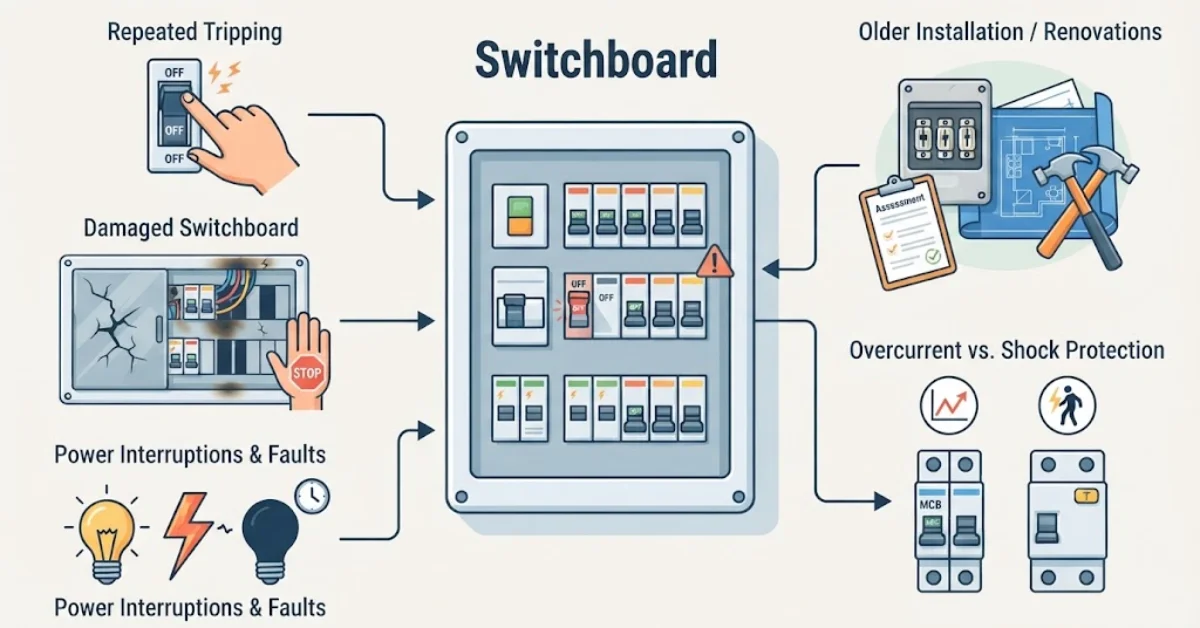
Electrical protection deserves attention when a circuit behaves unexpectedly or an installation no longer suits the property’s needs. Repeatedly restoring power without identifying the underlying cause can leave the original problem unresolved.
Consider arranging a professional assessment if you notice:
- Circuit breakers that repeatedly trip or will not remain on.
- Damaged switchboard components, missing covers or visible deterioration.
- Repeated power interruptions or unexplained electrical faults.
- An older installation that needs assessment before renovations or additional circuits.
- A need for switchboard improvements or changes to electrical protection.
Do not remove switchboard covers, handle exposed electrical components or attempt to replace internal fuses yourself. Electrical equipment can remain hazardous even when a circuit appears to be switched off.
It is also important to distinguish overcurrent protection from electric shock protection. A standard fuse or circuit breaker does not perform the same function as a safety switch, also known as a residual current device (RCD). These devices address different hazards, and an appropriately designed installation may require both forms of protection.
Frequently Asked Questions
Is a fuse better than a circuit breaker?
Neither is universally better. Each has advantages depending on the application, device specifications and electrical system. The right choice is the one that provides suitable protection for the installation.
Can a fuse be replaced with a circuit breaker?
A conversion may be possible, but it requires an assessment of the existing wiring, switchboard compatibility, circuit ratings and applicable requirements. It should not be treated as a simple component replacement.
Why does a circuit breaker keep tripping?
Possible causes include an overloaded circuit, a faulty appliance, damaged wiring or another electrical fault. Repeated tripping should be investigated by a qualified electrician rather than addressed by repeatedly resetting the breaker.
Are automatic fuses the same as circuit breakers?
The term can be used loosely, so it is important to identify the actual device. A conventional fuse interrupts current through a melting element, whereas a circuit breaker uses a switching mechanism to open the circuit.
Do circuit breakers need maintenance?
They can deteriorate or become unsuitable as an installation changes. An assessment may be appropriate if a breaker trips repeatedly, shows damage or operates abnormally.
Conclusion
Fuses and circuit breakers both play important roles in electrical safety, but their operating mechanisms, replacement requirements and applications differ. Understanding those differences can help you recognise when electrical equipment needs attention and why choosing protection based on the actual installation matters.
If your property has recurring electrical faults, an older switchboard or protection equipment that needs assessment, Vamp Electrical Solutions can help you understand the next steps. Our electrical services include fault finding, repairs and switchboard upgrades, with recommendations tailored to the property’s requirements.
Call Vamp Electrical Solutions on 0420 102 214 to discuss your electrical concerns and arrange professional assistance.